
ChordSmith
Sixty instruments. Solved.
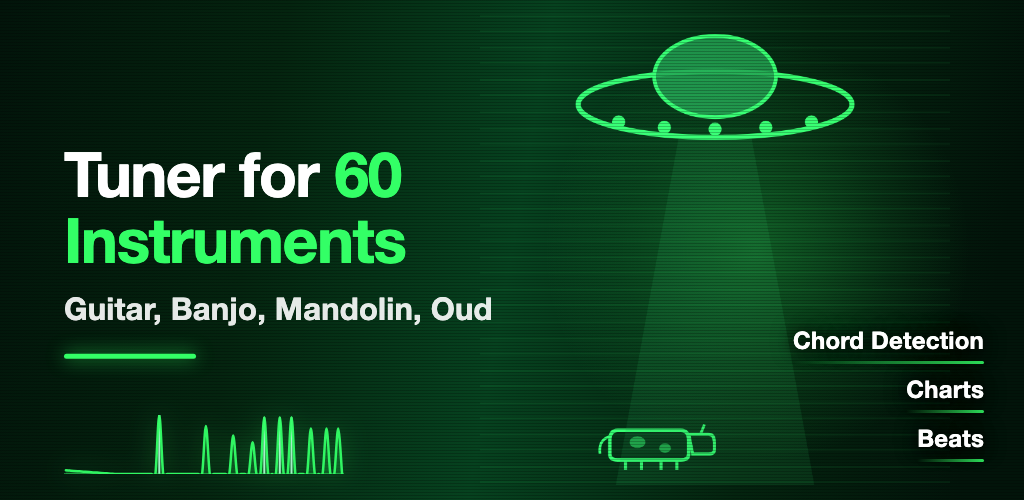
A chord finder, a chromatic tuner and a drum machine built for the same instrument — yours. Every voicing is computed for the tuning you are actually in, not looked up in a table for standard.


A chord finder, a chromatic tuner and a drum machine built for the same instrument — yours. Every voicing is computed for the tuning you are actually in, not looked up in a table for standard.
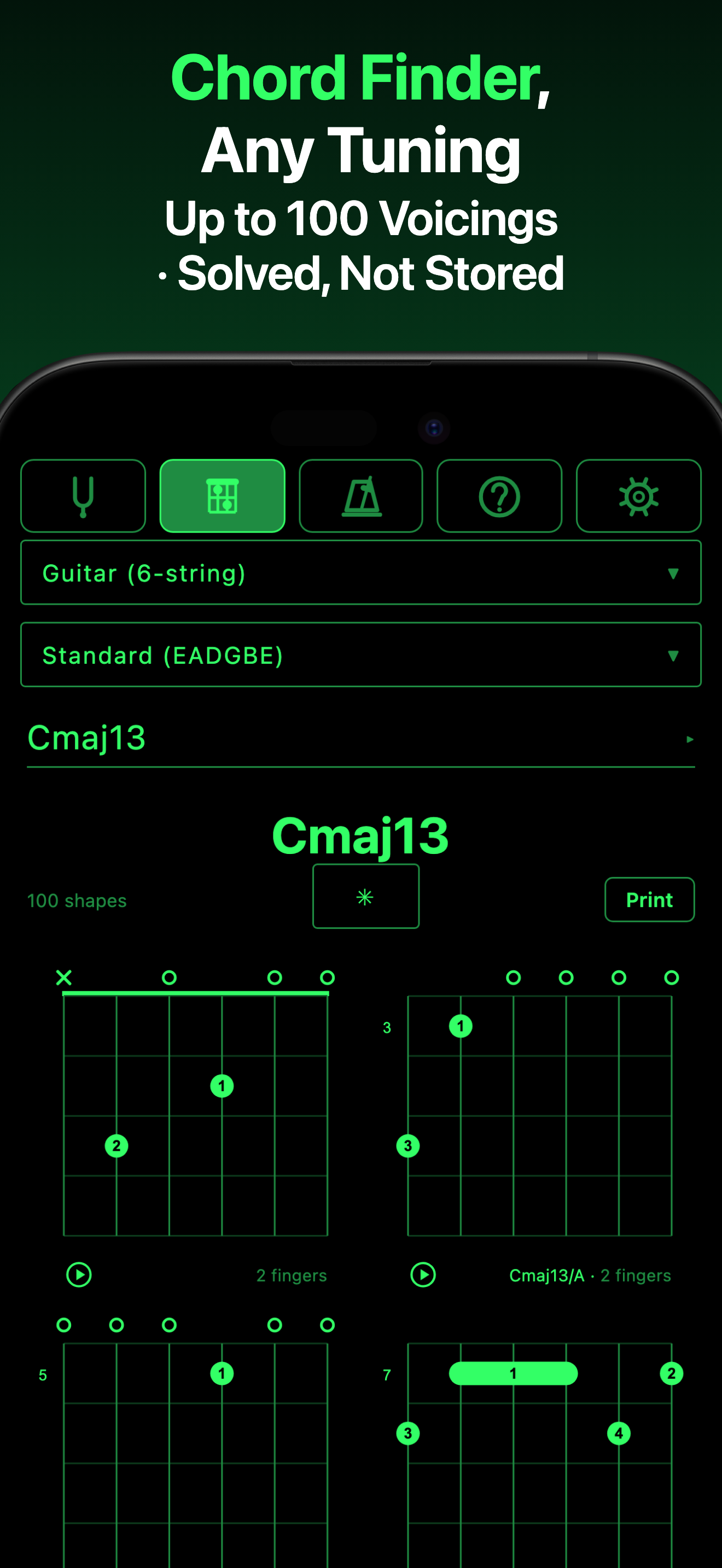
Pick a chord and see how to play it on the instrument in your hands, in up to 100 voicings, ordered from the easiest shape upward. Slash chords, extensions, and the plain triads — each drawn on your instrument's own neck, with the fingering in front of you.
Change the tuning and the shapes change with it — every voicing is computed for the strings you actually have, not looked up in a table for standard tuning. Retune the B string down a half step and every chart on the screen re-solves itself. DADGAD, drop D, open G and every other preset is one tap away.
That is the difference the name is about: the shapes are solved, not stored.
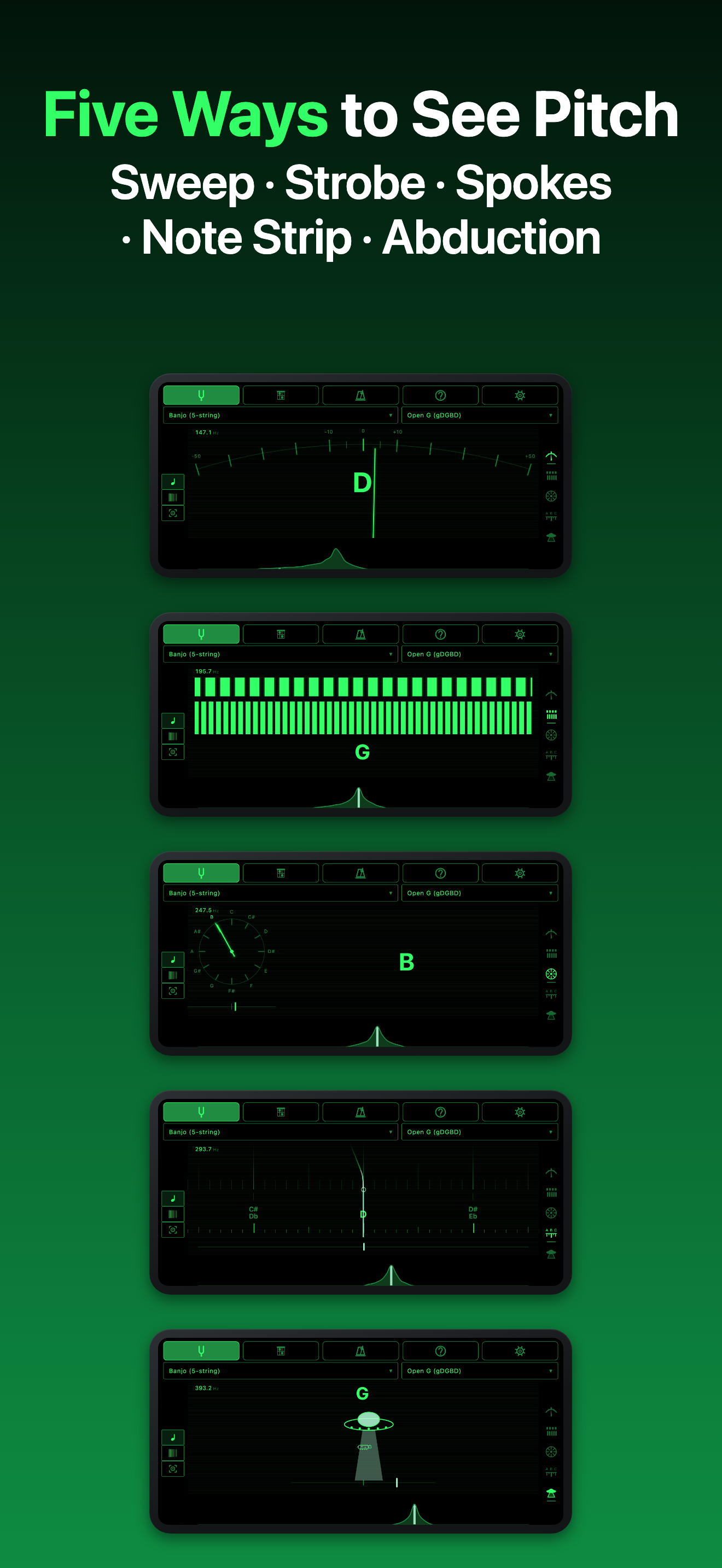
Five displays to choose between: a sweep needle, a strobe for last-cent work, chromatic spokes, a continuous note strip, and one you will want to see for yourself. The engine underneath is the same — pick the display that matches how you tune.
Every instrument carries its own tunings, drop and open included. Tune until the reading turns pale green — that is within one cent, which is closer than the ear can hear.
Set your reference by ear as well as by number: play a note from a piano, a drone or another player's instrument and the app takes its pitch as the tonic — which is how you tune to an ensemble that is not at A=440. Concert A itself moves between 415 and 466 Hz for period or ensemble pitch.
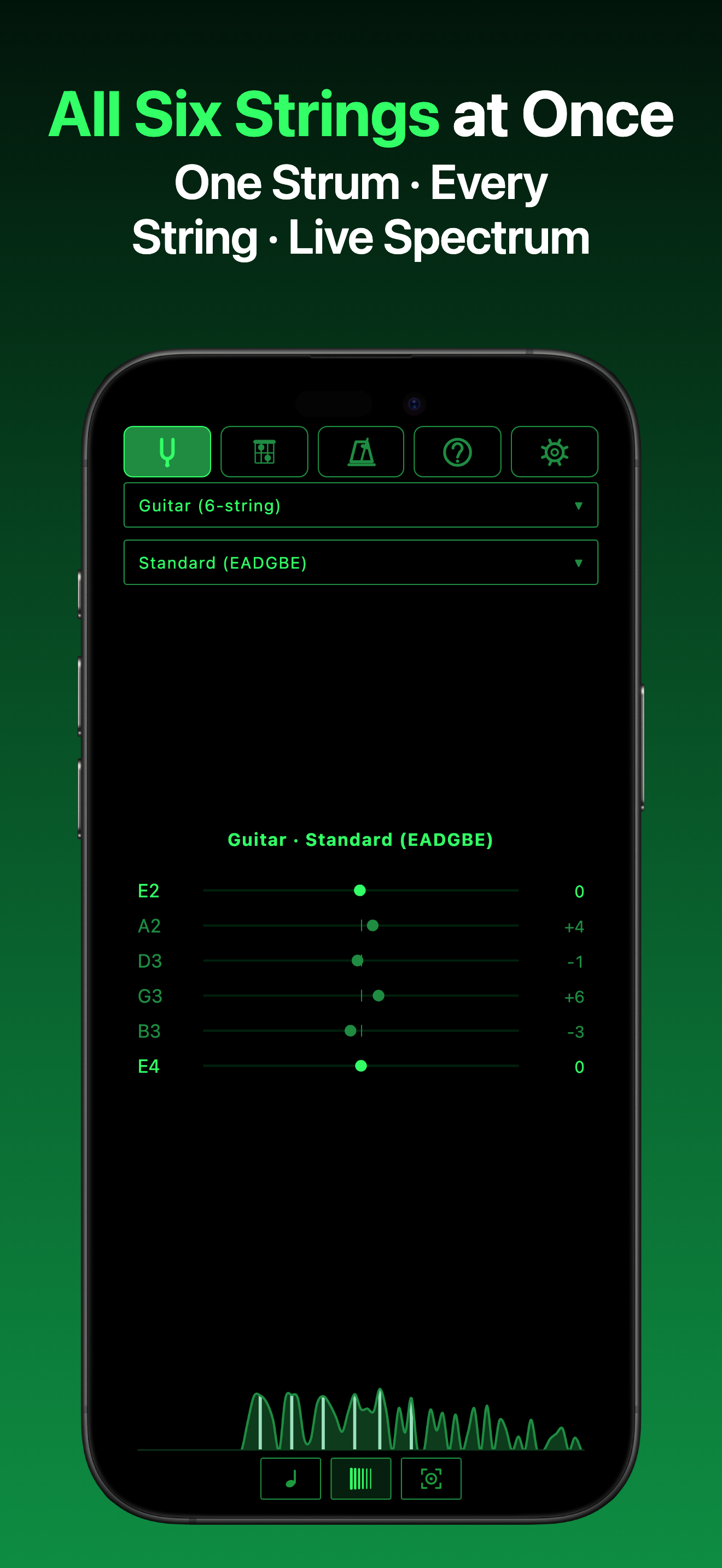
One strum, every string, read against a live spectrum — so you see the flat D before you have finished with the G. No plucking one string at a time unless you want to.
The spectrum runs underneath every display, all the time: what the microphone hears, drawn as it happens, with the fundamentals of your strings marked on it. When something is off, you can see which something.
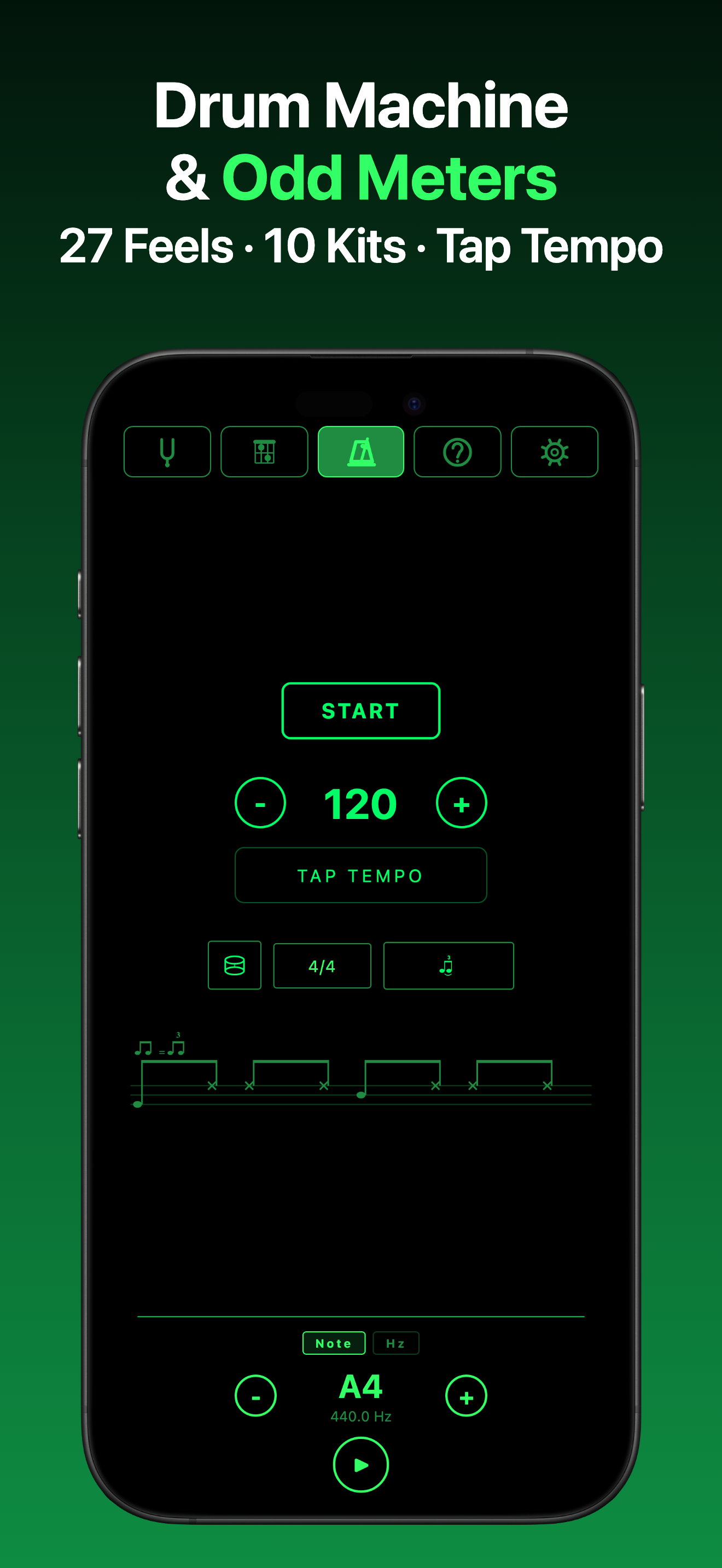
Ten kits — standard, click, electric, 808, Latin, cajón, djembe, darbuka, tabla and taiko — and twenty-seven feels, from straight eighths and a swung shuffle through son and rumba clave, bossa nova, the reggae one-drop, bembé, tresillo, maqsum and malfuf.
Tap tempo, a BPM counter, compound and odd meters, and an accent pattern you edit — so 7/8 sounds like the 7/8 you are counting, not the one the metronome assumes.
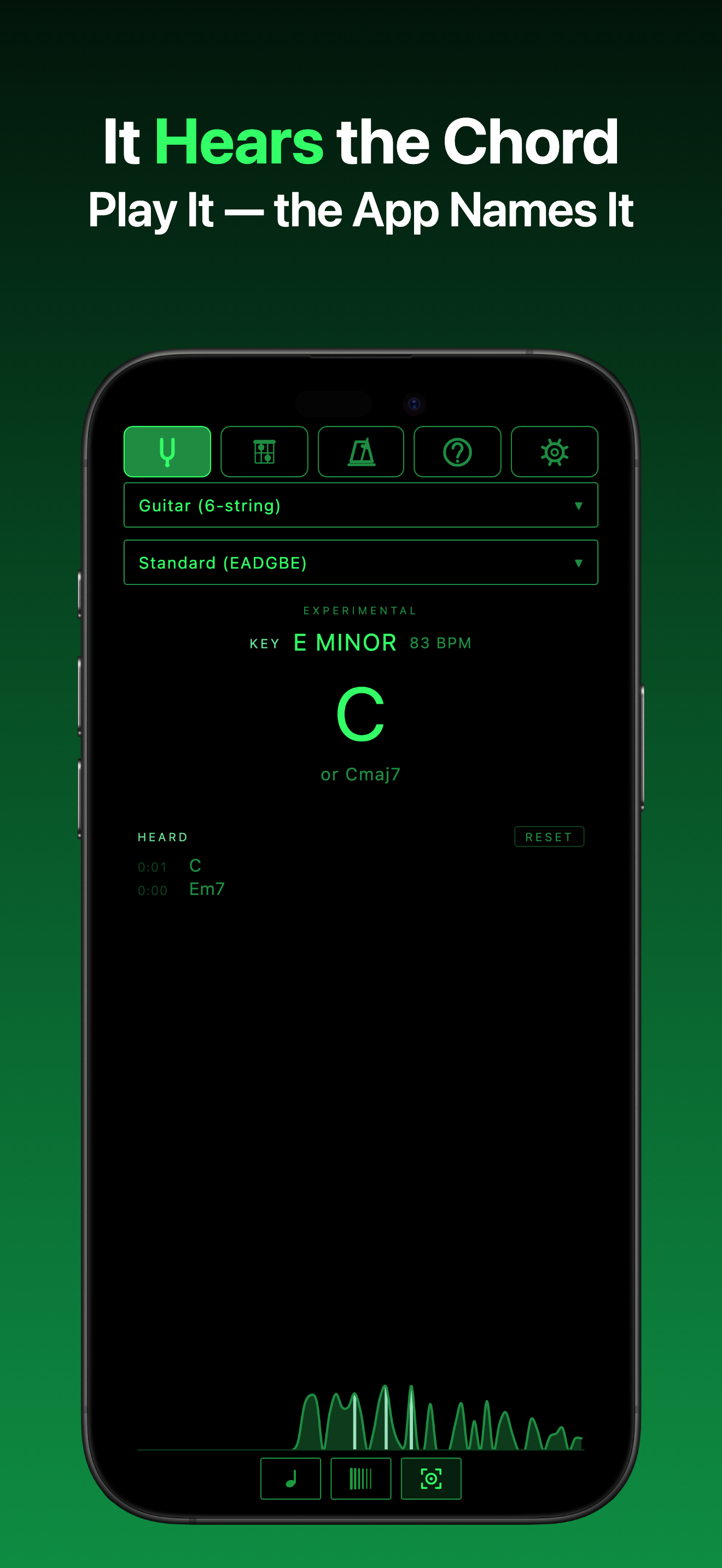
Play a chord and the app names it, tracks the key as you go, and keeps a running transcript of what it heard — so at the end of a writing session you have the changes, not a memory of them.
The spectrum analyser runs on the room rather than on a preset, so it works with no instrument selected at all — a chord from the stereo, a piano across the room, whatever is ringing.
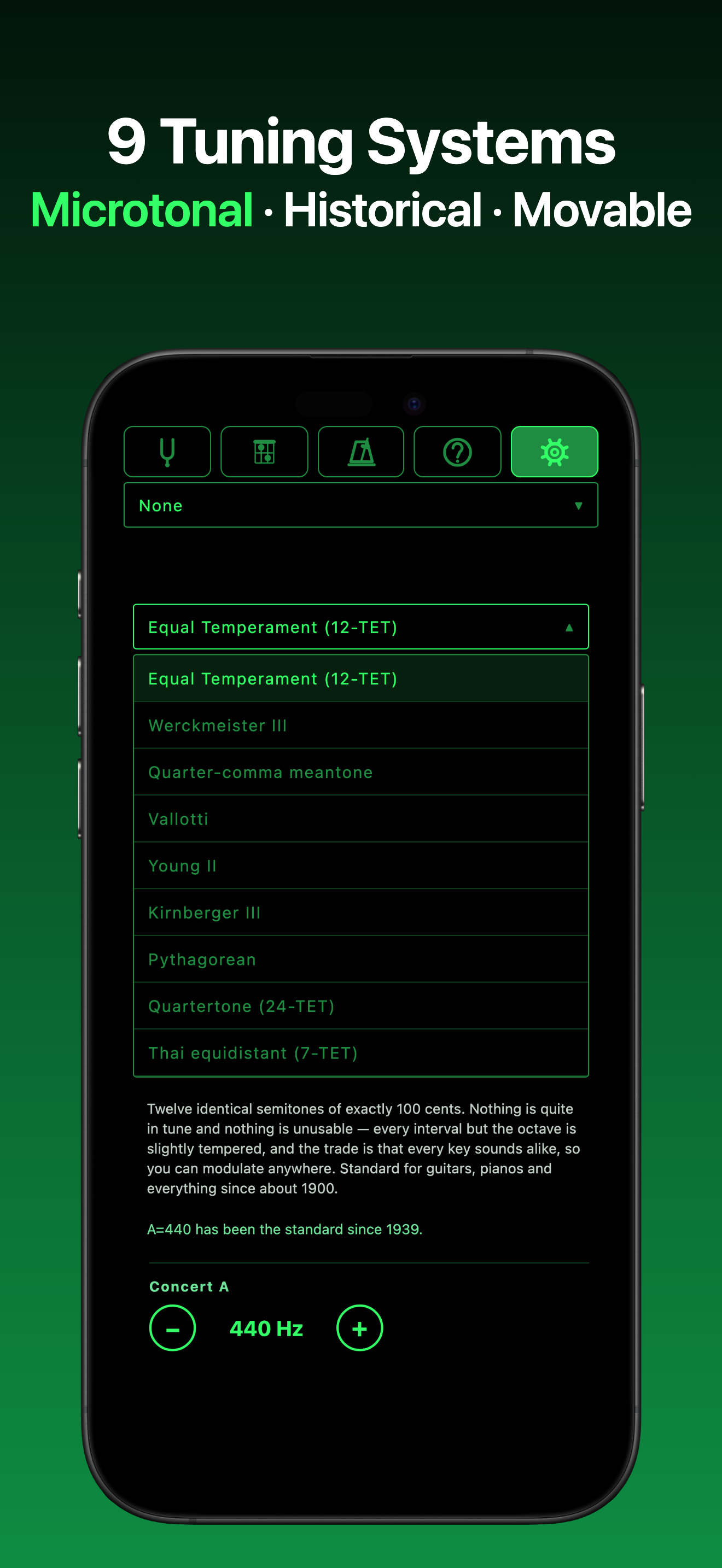
Equal temperament, and the ones that came before it: Werckmeister III, quarter-comma meantone, Vallotti, Young II, Kirnberger III and Pythagorean, with a temperament octave for tuning a piano, harpsichord or clavichord by ear.
Quarter-tones as 24-TET for maqam, and Thai equidistant 7-TET for the krachappi, the phin and the saw. Each system comes with a plain-language note on what it is, what it is for, and why it sounds the way it does.
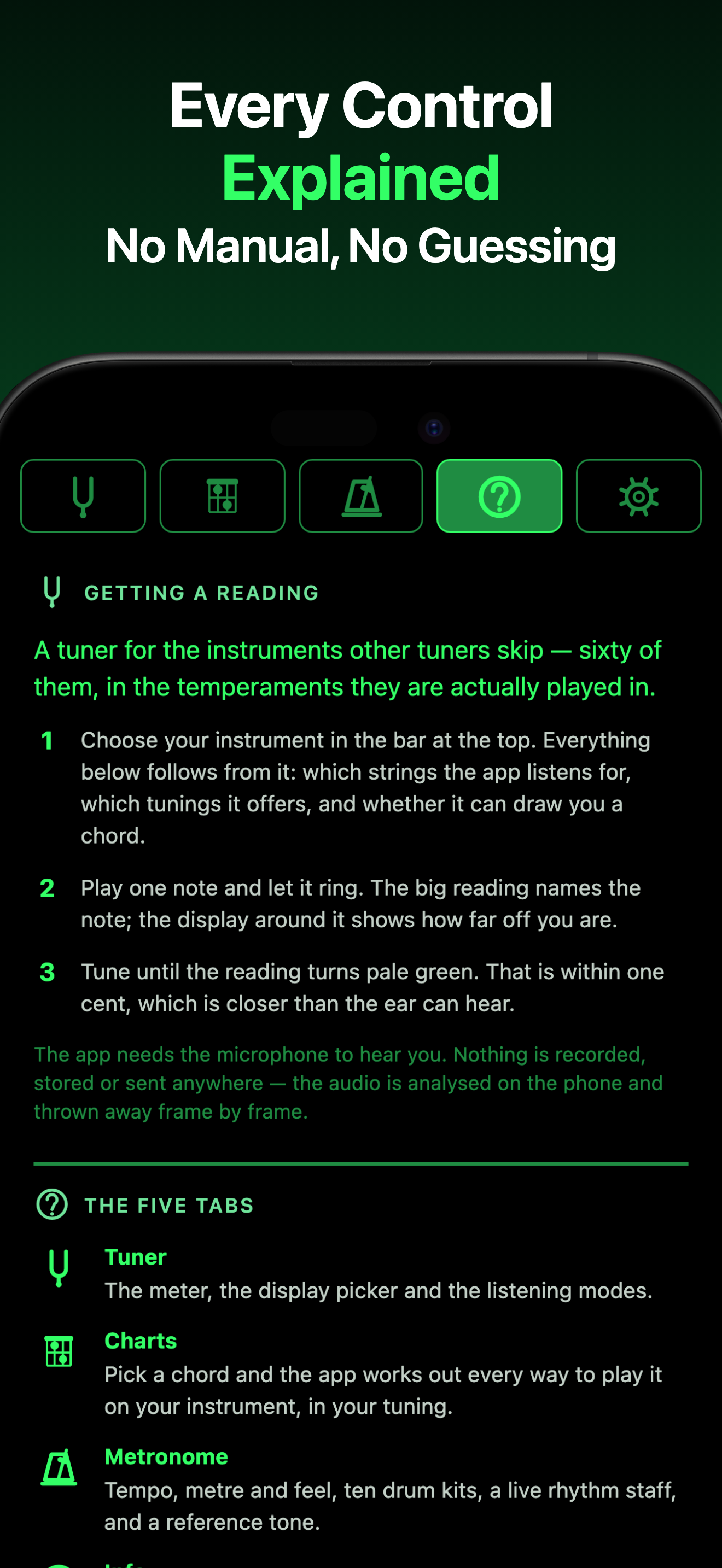
A whole tab of the app is documentation — every control, every display, every temperament explained in plain language, next to the thing it explains. No manual to download, no guessing what a knob does.
Choose your instrument and everything follows from it: which strings the app listens for, which tunings it offers, and whether it can draw you a chord. Play one note, let it ring, tune until the reading turns pale green. The app tells you all of this itself.
From six-string guitar and four-string bass through the orchestral strings, and on around the world. Every one with its own strings, its own tunings, and — where the tradition has no fixed pitch — its own way of asking for a tonic instead.
Guitar in six, seven and eight strings and the Russian seven; bass in four, five and six; ukulele in three sizes; mandolin, five-string and tenor banjo, violin, viola, cello, double bass and the Hardanger fiddle; cavaquinho, viola caipira, vihuela, guitarrón, bajo sexto, cuatro, charango, bandurria and laúd; Greek bouzouki in tetrachordo and trichordo, the Irish bouzouki, Turkish and Arabic oud, bağlama, gambus; erhu, pipa, guqin, guzheng, koto, gayageum, shamisen, sanshin; sitar, tanpura, veena and the Carnatic violin; balalaika, domra, dombra, morin khuur, nyckelharpa, kantele; krachappi, phin, saw duang, saw u and the đàn ghi-ta phím lõm; piano, harpsichord and clavichord.
The tuner and the detector run entirely on your device — nothing you play is recorded, uploaded, or sent anywhere. The app works with no network connection at all, which matters more in a rehearsal room than it does in a shop.